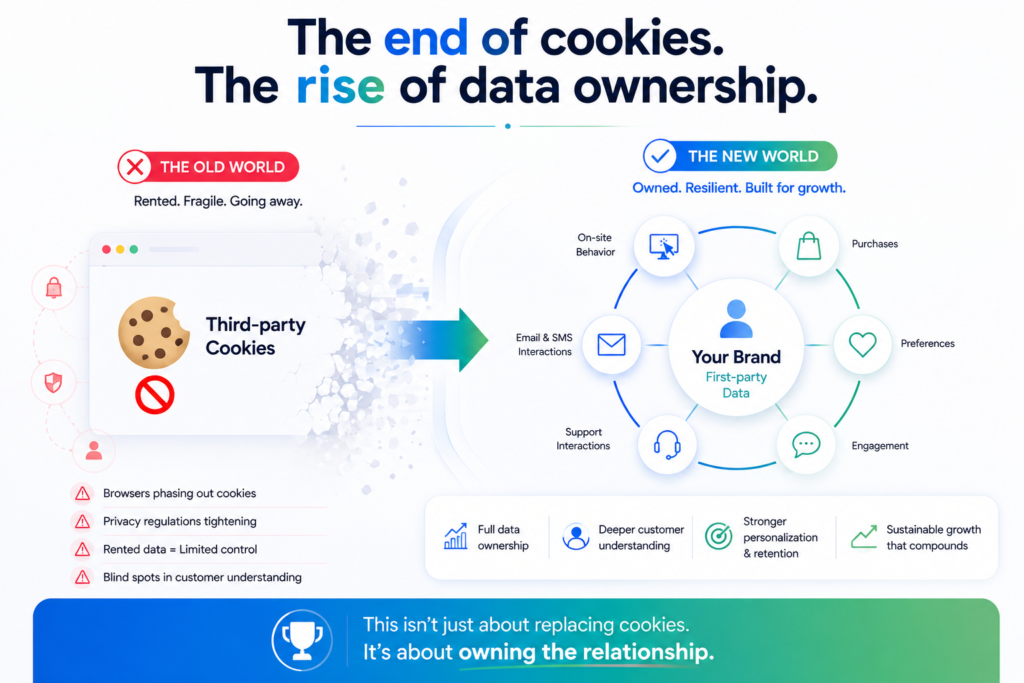
Third-party cookies have quietly powered most of ecommerce’s targeting and retargeting stack for over a decade. That era is closing, browsers are phasing cookies out, privacy regulations are tightening, and the D2C brands that built their growth engine on rented data are now staring down a blind spot they didn’t plan for.
But here’s the part most “cookieless” content skips: this isn’t really a tracking problem. It’s a data-ownership problem. And brands that treat it as an ownership opportunity, rather than a technical workaround, are going to come out ahead, not just compliant, but with a sharper read on their customers than cookies ever gave them.
This article is the practical follow-up to that idea: what first-party tracking actually looks like in practice, and how to start building it.
Why “finding a cookie replacement” is the wrong goal
A lot of the current conversation around cookieless tracking is about substitution, swapping third-party cookies for some other identifier that does roughly the same job. That’s a trap. It optimizes for keeping an old system alive instead of asking what a better system would look like.
Third-party cookies were always a proxy. They told you where someone had been, not what they were doing right now, and the data was never really yours, it lived in someone else’s pipeline, subject to someone else’s policy changes. First-party tracking flips that: the brand owns the collection, the storage, and the interpretation of the signal. That ownership is what makes real-time behavioral response possible in the first place.
What first-party behavioral tracking actually captures
Cookie-based targeting worked off static, historical segments: “visited category page in the last 30 days,” “clicked an email link last week.” First-party behavioral tracking works off live signals, captured directly on your own site or app:
- Scroll depth and dwell time — how far someone reads on a product page, and how long they linger.
- Hover and re-visit patterns — a shopper who circles back to the same product three times without clicking is signaling something different than a first-time visitor.
- Search behavior — what people search for on-site, and what they abandon without clicking a result.
- Cart and checkout interactions — additions, removals, and exactly where in the checkout flow someone drops off.
- Session-to-session continuity — recognizing a returning visitor’s intent without needing a third-party identifier to stitch the journey together.
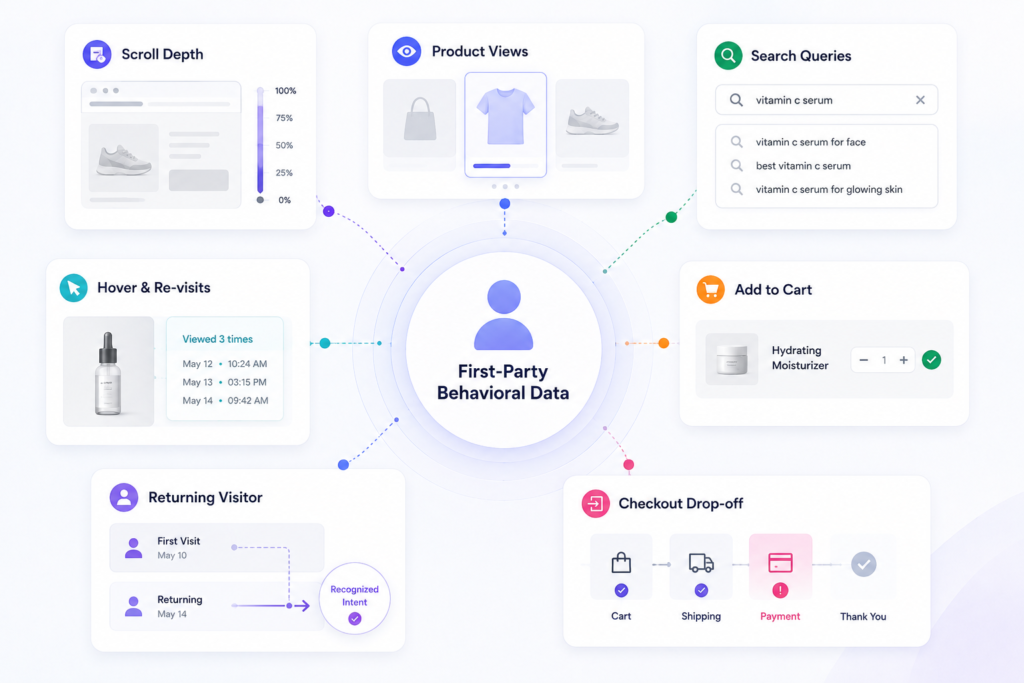
None of this requires borrowing data from an ad network or a data broker. It’s generated the moment a visitor interacts with a brand’s own site, which is what makes it both privacy-resilient and immediately actionable.
Cookies vs. first-party behavioral tracking
| Areas | Third-party cookies | First-party behavioral tracking |
| Data ownership | Rented from ad networks/brokers | Owned entirely by the brand |
| Signal type | Historical (past clicks, past visits) | Real-time (current session intent) |
| Granularity | Broad segments | Individual visitor behavior |
| Regulatory exposure | High — subject to third-party consent chains | Lower — direct first-party consent relationship |
| Durability | Being phased out across major browsers | Not dependent on browser cookie policy |
| Actionability | Retroactive retargeting | In-the-moment personalization and recovery |
Privacy is the foundation, not a constraint
Because this shift is entirely first-party, brands are collecting behavior directly from visitors who are already on their site or app, which puts them in a fundamentally stronger position under privacy regulations like GDPR and India’s DPDP Act than third-party cookie chains ever were. There’s a direct consent relationship, no hidden intermediary, and no dependency on a data broker’s compliance posture. Privacy-first isn’t a limitation on what’s possible here, it’s what makes the real-time model work at all.
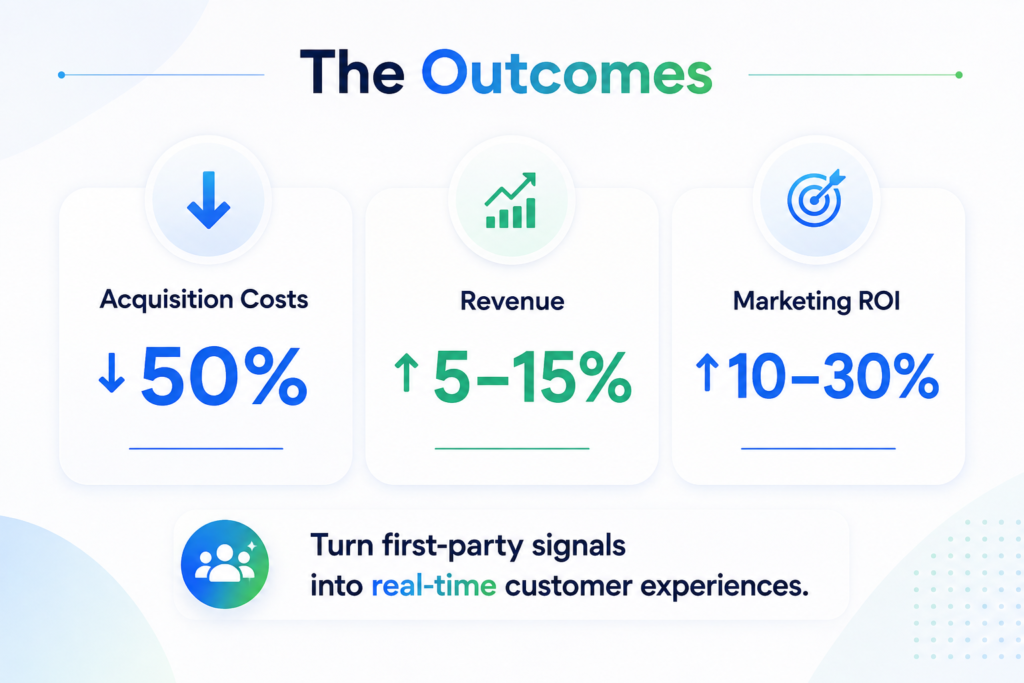
The Outcomes
Personalization can reduce customer acquisition costs by up to 50%, lift revenue 5–15%, and grow marketing ROI 10–30%, gains that depend on exactly the kind of real-time visitor data first-party tracking captures.
Where to start
You don’t need to rebuild your entire stack to start this. Start with the audit, most brands are surprised by how much first-party signal they’re already generating and simply not capturing or using. From there, the shift to real-time behavioral tracking is a matter of sequencing, not a ground-up rebuild.
This is exactly the problem we have been building toward at Cognidots, systems that read these real-time signals and turn them into a rich, first-party visitor profile, built entirely on data the brand already owns.
Want to see what this looks like for your catalog and traffic?
Fill out the form below to set up a quick 15-minute call, and we will get you a 14-day free trial to test it in your own context, no commitment required.
Leave a Reply